
Walk into two homes for sale.
The first is spotless, beautifully maintained, and filled with furniture, artwork, collections, family photographs, colorful decorations, and personal objects the homeowner has spent years accumulating. Nothing is necessarily wrong with it. In fact, everything in that home reflects a life well lived and a genuine sense of personal taste.
The second home feels calm. The furniture is carefully arranged. The colors are soft and understated. The rooms feel larger than their square footage suggests. Natural light moves through the space without obstruction. Every chair, lamp, pillow, and accessory appears to have a purpose. Nothing competes for your attention.
Which home is more likely to receive stronger offers?
For most buyers in the Washington DC, Maryland, and Northern Virginia market, it is the second one, and the reason has very little to do with decorating. It has everything to do with psychology, and understanding that distinction is one of the most important things a Realtor can communicate to a seller before a listing goes live.
For a look at how professional home staging services consistently reduce days on market across DMV listings: https://harvardhomeservices.com/will-home-staging-help-sell-faster-washington-dc/
Buyers Make Hundreds of Decisions Before Every Showing
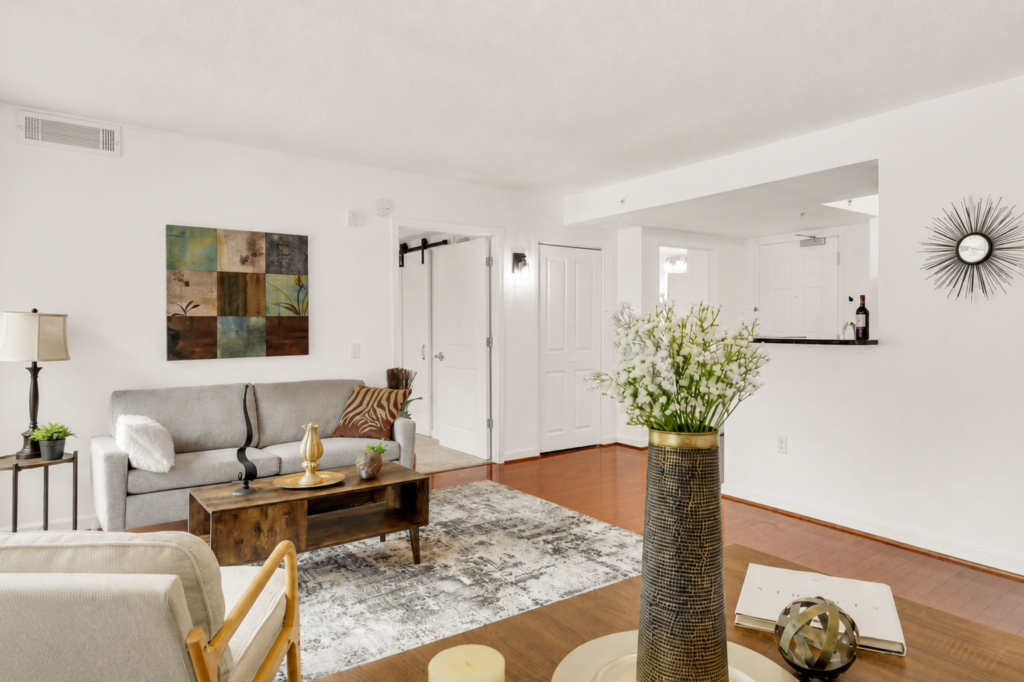
Every object inside a home asks a buyer to make a tiny decision.
“I like that painting.” “I don’t like those curtains.” “Where would my sofa fit?” “I would have to repaint this room.” “I wonder why they put that cabinet there.” “The dining table seems too big for the space.”
The human brain processes these micro-judgments almost instantly and largely without the buyer being aware it is happening. By the time they have walked through several rooms, they have made hundreds of small decisions, and the cumulative weight of those decisions matters enormously to the outcome of the showing.
Psychologists call this decision fatigue, the mental exhaustion that builds as a person makes repeated choices throughout the day. When people become mentally tired, they become less confident, less decisive, and more cautious. In the context of a home staging showing in Washington DC, caution is the enemy of an offer. A buyer who feels overwhelmed by a space is a buyer who walks away without writing a number. That is the psychological mechanism that makes cluttered and over-personalized listings consistently underperform their price point regardless of the home’s actual condition or location.
The way buyer psychology shapes the entire showing experience, from the moment a buyer walks through the door to the moment they decide whether to write an offer, is covered in detail here: https://harvardhomeservices.com/home-staging-dopamine-buyer-psychology-washington-dc/
Effective Home Staging Services Remove Decisions

Professional home staging in Washington DC is not about making a house look expensive. It is about making it feel effortless.
Every unnecessary object that is removed from a home eliminates another decision the buyer no longer has to make. Instead of standing in a room wondering what they would change, what they would move, or what the seller’s taste says about the home’s hidden condition, buyers begin imagining what they would add. That subtle shift in mental posture changes the entire dynamic of the showing. The home no longer belongs to the seller. It begins to belong to the buyer walking through it.
This is why the curation process, removing items rather than adding them, is often the most impactful work Harvard Home Services does before a listing goes live. The goal is not to create an interior that impresses people. The goal is to create an interior that gets out of the buyer’s way and lets the home itself do the communicating. You can see exactly what that looks like across recent Harvard Home Services staging projects here: https://harvardhomeservices.com/recent-staging-projects/
For sellers trying to understand which rooms carry the most weight in buyer decision making and where a limited staging budget will produce the strongest return in the DC market: https://harvardhomeservices.com/which-rooms-to-stage-first-budget-washington-dc/
Simplicity Creates Confidence

One of the most persistent misconceptions about home staging services is that adding more furniture and more accessories creates a more attractive showing experience. Sellers assume that a fuller room looks more complete, more appealing, more finished.
Well-executed staging creates visual breathing room. Rooms feel larger because they are not fighting against oversized furniture or competing visual elements. Hallways become easy to move through. Natural light travels farther across open floor plans. Architectural details that buyers are actually paying for, crown molding, hardwood floors, high ceilings, large windows, become visible and prominent rather than competing with décor for attention. The eye knows exactly where to look when it enters a room, and that sense of visual clarity is something buyers recognize and respond to even when they cannot articulate why.
Rather than overwhelming a buyer with information and asking them to filter through layers of personal style, a professionally staged home in Washington DC quietly guides their attention from one feature to the next. Buyers do not feel distracted. They feel comfortable. Comfort builds confidence. Confidence is what produces offers.
The design language Harvard Home Services uses to create that sense of calm without creating emptiness is built on texture, intentional accent pieces, and cultural depth rather than volume. The tactile staging approach that underpins much of this work is explained here: https://harvardhomeservices.com/tactile-home-staging-washington-dc/
The way physical staging and digital presentation work together to build buyer confidence before a single showing ever happens: https://harvardhomeservices.com/2d-vs-3d-home-buying-experience-staging/
Powerful Staging Is Almost Invisible
When buyers leave a beautifully staged home, they rarely say “I loved the sofa” or “that artwork was stunning.” What they say is “that house just felt right.” They cannot always name what produced the feeling, and that is precisely the point.
Great home staging does not sell furniture. It sells emotion. The furnishings, lighting, textures, artwork, greenery, and spatial arrangement all work together to create a feeling that buyers carry with them long after they have left the property. When buyers remember how a home made them feel, they are far more likely to schedule a second showing, write an offer, or compete against other interested parties rather than waiting to see what else comes to market.
This is also why professionally staged homes consistently outperform both vacant homes and occupied unstaged homes in listing photography. A staged home communicates differently at the digital stage than an unstaged one, and in a market like Washington DC where buyers are often relocating from other cities and doing significant research before they ever set foot in a property, that digital first impression carries real weight: https://harvardhomeservices.com/de-influencing-your-home-before-you-sell-washington-dc/
The Asian accent pieces and culturally layered design elements Harvard Home Services incorporates are a specific example of how intentional staging creates a memorable showing experience that buyers recall when they are reviewing their options: https://harvardhomeservices.com/asian-accents-home-staging/
This Is Why We Focus on Psychology Before Design
At Harvard Home Services, beautiful interiors are a byproduct of the work, not the objective.
The actual objective is to help buyers emotionally connect with a home within the first few minutes of walking through the front door. That means selecting textures that feel inviting rather than visually demanding. Using light to create warmth and a sense of openness rather than simply illuminating a space. Reducing visual distractions so that the architecture and proportions of the home can communicate their value without anything competing with them. Creating a natural flow from room to room that makes the whole property feel cohesive and considered rather than assembled over time.
For sellers preparing a home for sale in Washington DC, Maryland, or Northern Virginia who are evaluating whether physical staging or virtual staging makes more sense for their specific situation: https://harvardhomeservices.com/virtual-vs-physical-staging-washington-dc/
And for investors and property managers in the DC market, the same psychology that drives faster sales in residential listings also applies directly to rental properties and lease-up timelines: https://harvardhomeservices.com/why-staging-rental-properties-increases-long-term-roi-in-washington-dc/
The Bottom Line
If a listing is not attracting strong offers in the Washington DC market, the problem is rarely the price alone and it is often not the condition of the home. More frequently it is the showing experience itself, specifically the number of decisions the space is asking buyers to make before they can begin to picture themselves living there.
Professional home staging services remove those mental obstacles systematically. They allow buyers to stop processing and start feeling. And that shift from evaluation to emotion is what separates listings that sit from listings that close.
At Harvard Home Services, we do not simply stage homes. We influence the way buyers experience them, and that influence is what produces results like 306 days on market reduced to 5 days after a single staging intervention in Fort Washington, Maryland: https://harvardhomeservices.com/306-days-on-market-fort-washington-home-staging-harvard/
Work With Harvard Home Services
Whether you are a homeowner preparing to sell or a Realtor looking for a home staging partner across Washington DC, Maryland, and Northern Virginia, Harvard Home Services provides professional staging, design consultation, and pre-listing preparation that helps homes perform from the first showing forward.
https://harvardhomeservices.com/contact/
https://harvardhomeservices.com/services/
https://harvardhomeservices.com/about/