
How Neuroscience, Reward Anticipation, Cognitive Fluency, and Loss Aversion Help Explain Why Staged Homes Feel Different to Buyers
Introduction
Jacob and Gwendola had just relocated to Washington DC from Boise, Idaho. They were excited about their new life in the city and completely unprepared for what DC real estate was going to feel like from the inside. Their Realtor showed them two homes that afternoon. Similar price. Similar size. Similar location. The first home was completely empty. The second had been professionally staged by Harvard Home Services.
What happened next had nothing to do with furniture preferences or decorating taste. It had everything to do with how their brains processed what they were experiencing.
The human brain is constantly receiving visual information, predicting outcomes, assigning value, and deciding what deserves attention. A home can influence that process long before a buyer consciously says they love it. That is why professional home staging in Washington DC is not simply about making a property look attractive. It is about creating an environment that helps a buyer see the space, understand it, and begin to imagine their life within it. Three specific psychological mechanisms drive that process, and understanding them is one of the most useful things a Realtor can explain to a seller before a listing goes live.
For a foundational look at how the first impression a listing makes determines buyer behavior before anyone walks through the door: You Never Get a Second Chance to Make a First Impression
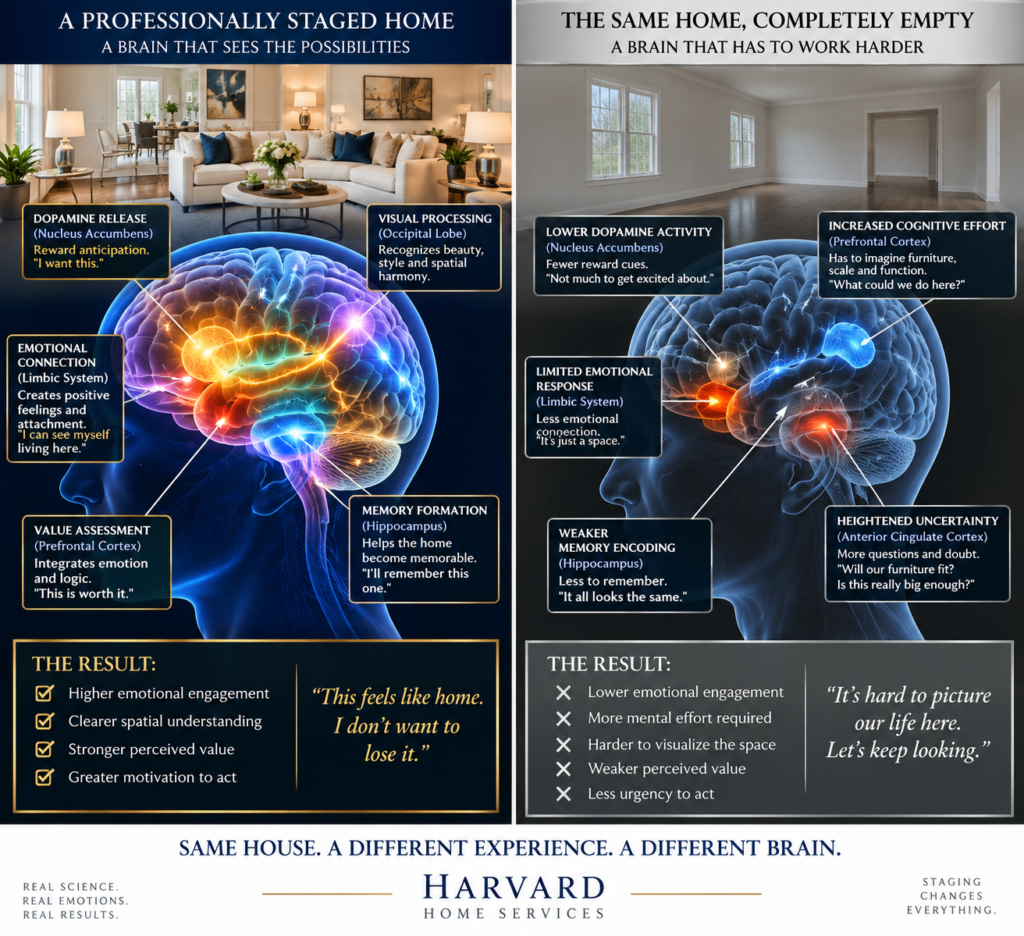
1. Reward Anticipation: “I Want This.”
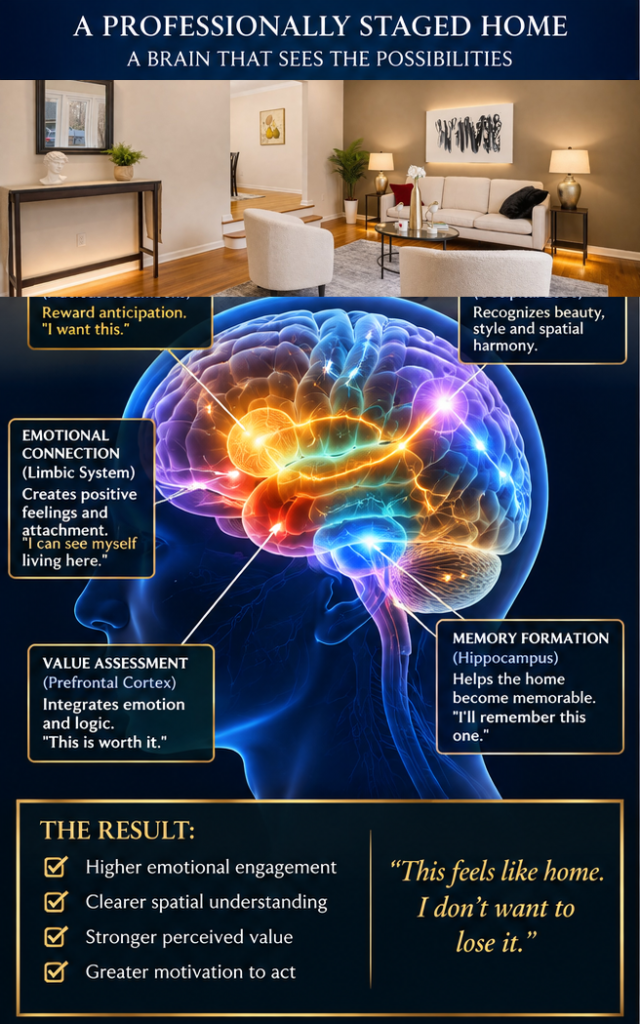
When Jacob and Gwendola walked into the professionally staged home, their brains immediately encountered cues associated with a desirable future. A beautifully arranged living room suggested relaxation and comfort. A dining table suggested entertaining friends and family. A carefully designed bedroom suggested rest. Their brains began constructing a future experience before they had processed a single rational thought about the property.
This is where dopamine becomes relevant, though not in the simplified way the word is usually used. Neuroscience shows that dopamine is deeply involved in reward prediction, motivation, learning, and goal-directed behavior. Jacob was not simply looking at a sofa. His brain was beginning to ask what life would feel like in this space. Gwendola was not simply looking at a dining room. She was already imagining herself using it. The empty house produced far fewer of these cues, and the result was a very different cognitive experience. Jacob saw an empty room. Gwendola saw an unfinished mental picture.
Professional home staging in Washington DC gives buyers something concrete from which to build an emotional connection. Instead of asking buyers to invent a lifestyle from scratch, the home begins to demonstrate what that lifestyle could look and feel like. The goal is not to manipulate a buyer’s decision. The goal is to make the property’s possibilities visible. That is a meaningful distinction, and it is one that the best Realtors in the DC market understand instinctively.
For a deeper look at how Harvard Home Services has applied this principle across real listings with measurable results: Why Buyers Fall in Love With Some Homes and Walk Away From Others
2. Cognitive Fluency: “I Understand This.”
The professionally staged home gave Jacob and Gwendola’s brains something extremely valuable beyond aesthetics: information. Furniture established scale, so they could immediately understand how their own belongings would relate to the space. Placement established function, so every room communicated a clear purpose. Lighting directed their attention toward the home’s best features. Texture created visual richness that made the space feel complete and considered. Together, these elements helped them understand the environment without having to work to interpret it.
The empty home required a fundamentally different kind of mental effort. Jacob had to ask whether his sofa would fit. Gwendola wondered where the dining table would go. They had to mentally construct all the possibilities themselves, asking what each room would feel like furnished, whether the living room would actually be large enough, and whether the space would feel warm or simply vacant. That cognitive effort is not neutral. When something requires more mental work to understand, it is harder to appreciate, harder to remember positively, and harder to feel emotionally drawn to.
This is one of the most powerful and most underappreciated reasons why professional home staging in Washington DC produces better outcomes than empty listings. Staging establishes scale, purpose, and possibility simultaneously. It allows buyers to understand the physical space while imagining their lives within it, and it does that work for them rather than asking them to do it alone. The empty house may have been perfectly good real estate. But the staged house communicated something the empty house could not: a clear, immediate answer to the question every buyer is really asking, which is whether they can see how their life works in this home.
For sellers who are evaluating whether staging is worth the cost and how to think about the financial return: What Every DMV Realtor Needs to Know About Staging for an Estate Sale
3. Motivation and Loss Aversion: “We Don’t Want to Lose This.”
At a certain point during the showing, something shifted for Jacob and Gwendola. They were no longer simply evaluating the property. Their brains had begun assigning it value, and the question had quietly changed from whether they liked the house to what they needed to do to get it. This is where motivation and loss aversion enter the process, and where the psychological stakes of staging become most visible.
People pay particular attention to the possibility of losing something they have already begun to value. The strength of this effect varies from person to person, but in real estate, where the emotional and financial stakes are both high, that shift can happen quickly and decisively. Gwendola looked at Jacob and told him she did not want someone else to get this one. Jacob was already thinking about the offer. That is a profoundly different psychological state from standing in an empty room and trying to imagine what might someday be there.
The empty house gave Jacob and Gwendola information. The professionally staged home gave them a reason to care. That distinction is what separates a listing that generates offers from a listing that generates showings without momentum. When a buyer has emotionally invested in a property, their decision-making process changes. They are no longer evaluating. They are competing. And the conditions for that shift are created, in large part, by the staging.
For a look at how this plays out across specific DC metro listings and what the results look like in terms of Days on Market: A Day in the Life of a Washington DC Home Staging Company
The Difference Is Not Furniture. It Is Experience.
Professional home staging in Washington DC cannot overcome an unrealistic price, a poor location, significant property defects, or a buyer’s rational judgment. But it can influence the psychological environment in which those judgments are made, and that influence is not trivial. For Jacob and Gwendola, the difference between the two homes they saw that afternoon was profound. The empty house required them to imagine a future. The Harvard Home Services staged home helped them experience the possibility of that future.
When a buyer can see a home, understand it, and emotionally value it, the journey from “I like this house” to “I want this house” becomes remarkably short. That compression of the decision timeline is not an accident. It is the result of staging decisions made deliberately around how people actually experience spaces. Furniture provides scale. Lighting creates mood and directs attention. Texture adds depth and sensory richness. Color influences emotional perception. Carefully selected furnishings communicate lifestyle. And the combination of these elements transforms a collection of rooms into something a buyer can imagine becoming their own.
According to the National Association of Realtors 2025 Profile of Home Staging, 83 percent of buyers’ agents reported that staging made it easier for buyers to visualize a property as their future home. Nearly half of sellers’ agents also reported reduced time on market when staging was used. Those findings align directly with what the psychology of reward anticipation, cognitive fluency, and loss aversion would predict. Buyers are human. They do not purchase square footage, walls, and ceilings in isolation. They purchase the possibility of a life.
The Harvard Home Services Approach to Home Staging in Washington DC
At Harvard Home Services, exceptional staging begins with understanding the property and the psychology of the person who will eventually buy it. Every engagement combines professional home staging, photography, and property presentation to create an experience that is sophisticated, welcoming, and emotionally compelling. For homes throughout Washington DC, Maryland, and Northern Virginia, that means looking well beyond individual pieces of furniture.
Harvard Home Services considers proportion, light, color, texture, and movement through the home. Most importantly, every staging decision is made around what a prospective buyer needs to see and feel to recognize the property’s potential. Because an empty house asks a buyer to imagine. A thoughtfully staged house helps a buyer experience the possibility. And sometimes, that is the difference between “it’s a nice house” and “this is the one.”
For Realtors preparing listings in the DC metro area and for sellers who want to understand what professional preparation actually involves: How to Select the Right Home Staging Company
And for a look at recent Harvard Home Services staging work across the DC metro area: Recent Staging Projects
Zero percent financing for sixty days. $650 to get started. Balance due at settlement.
Ready to Stage Your Next Listing?
Harvard Home Services partners with Realtors throughout Washington DC, Maryland, and Northern Virginia to prepare listings for market at the highest level. Services include:
- Professional home staging
- Luxury staging
- Real estate photography coordination
- Property preparation and cleaning
- Pre-listing consulting
Zero percent financing available for your sellers. $650 to get started, with the balance due at settlement from the proceeds of the sale.
William Milewski 202-361-5858 william.harvardhomeservices@yahoo.com
David Van Leeuwen 630-441-8000 david.harvardhomeservices@yahoo.com
Follow us on Instagram: instagram.com/harvardhomeservices
Find us on Thumbtack: Harvard Home Services on Thumbtack