
What a Staging Disagreement in Maryland Reveals About the Real Decision-Making Logic Behind Home Staging Washington DC
Introduction
During a recent staging in Maryland, William Milewski and his business partner agreed on everything in the living room. The furniture. The textiles. The lighting. The art. Everything except one thing: what to put in the empty left corner.
William wanted a Greek olive tree. His partner wanted a mirror. Not just any mirror. An oversized, dramatic statement mirror. The kind you might find in a room where Oprah would walk in and immediately feel at home.
They debated it. They disagreed. The mirror won.
The home then received 7 offers in under a week on market.
The olive tree vs. mirror debate is a small moment in a staging day, but it illustrates something that does not get discussed enough in home staging Washington DC: how professional stagers actually make decisions when a room is 95 percent complete and one corner is still asking a question. Because in staging, an empty corner is always asking a question. The only real debate is which answer serves the buyer best, and the decision process for getting there is more systematic than it might appear from the outside.
For a look at how staging decisions connect to the psychological triggers that drive buyer behavior in DC metro listings: What Happens in a Buyer’s Mind When They Walk Through Your Listing

How Professional Stagers Decide What Fills an Empty Space
An empty corner in an otherwise finished staged room is not a neutral absence. It is a visual gap that every buyer’s eye will find immediately and try to resolve. The question is not whether the corner needs something. The question is what that something should accomplish for the specific room it is in.
Every element a staging team places in a finished room is performing a function. It is either directing attention, adding scale, introducing texture, softening architecture, connecting the interior to the lifestyle the home enables, or resolving a visual tension that the buyer would otherwise carry out of the room with them without being able to name it. When a room is otherwise complete and one space remains open, the final piece has a specific job to do for that room rather than simply filling the gap.
The olive tree argument is a strong one. A Greek olive tree brings organic texture into a room that may otherwise feel too refined or too finished. It softens hard architectural lines. It connects the interior to something living and natural, which is one of the most powerful biophilic staging principles available, particularly in the Washington DC market where buyers consistently respond to the relationship between interior spaces and the natural environment surrounding them. A well-placed tree also draws the eye upward, which makes ceilings read as taller and rooms feel more generous than their actual dimensions.
The mirror argument is equally strong. An oversized statement mirror amplifies light and creates the perception of depth, making a room feel physically larger than it is. It gives the eye a destination and a visual anchor in a corner that might otherwise feel like a dead end. A mirror that is dramatic enough in scale reads as art, which means it adds personality and focal interest simultaneously. And in a room where the furniture is already doing the heavy work of establishing scale and lifestyle, a mirror gives buyers a moment of visual discovery that they carry with them out of the showing.
The way to choose between them is to ask what the room still needs, not what you personally prefer. If the room already has sufficient depth and light but lacks warmth and organic life, the olive tree. If the room needs light amplification, a strong focal point, and a piece that photographs at its best rather than competing with natural elements for the camera’s attention, the mirror. In the Maryland staging, the room got the mirror. The room also got 7 offers.
For a deeper look at how material and spatial decisions shape the buyer’s experience of a DC metro property from the first listing photograph through the showing: The Alchemy of Home Staging in Washington DC
What the Results Actually Say
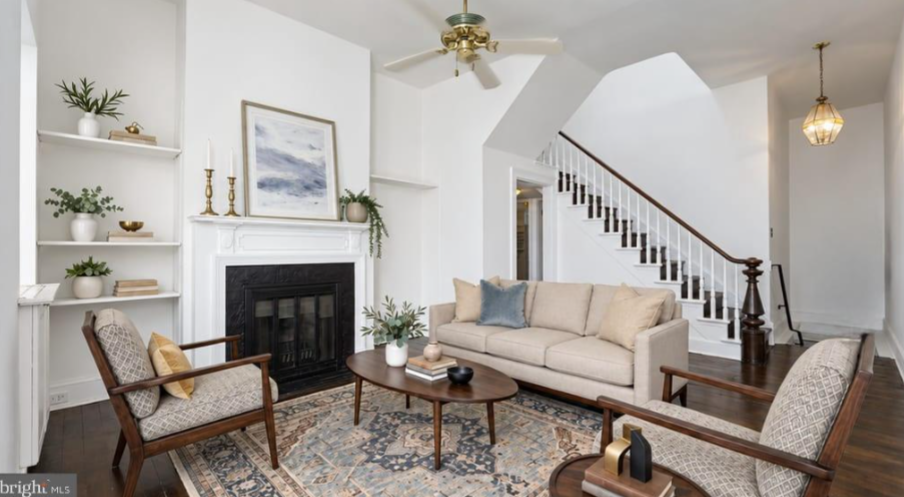
The two homes Harvard Home Services staged this week both sold in 4 days with multiple offers. The other homes on the market in the same area, without professional staging, are still sitting.
That gap between 4 days and still sitting is not a coincidence. It is the cumulative result of every decision made before those listings went live: the furniture selection, the scale, the placement, the lighting, the textures, the art, and the corner piece that two experienced stagers debated for longer than either of them would like to admit.
The homes that are still sitting are asking buyers to do work. They are asking buyers to imagine the furniture, to estimate the scale of the rooms, to mentally fill the empty corners, and to construct a version of the lifestyle the home could support from raw, uninterpreted square footage. That is a significant amount of cognitive and emotional effort to ask of a buyer who has already seen a dozen other listings that week and has a clear sense of which ones felt like a home and which ones felt like a vacancy.
The staged homes did not ask buyers to do that work. They answered the questions before the buyers thought to ask them. And when a buyer walks into a room where every question has already been resolved, including the corner question, they stop evaluating and start imagining. That shift is where offers come from.
The Corner Question Is Really the Buyer Question
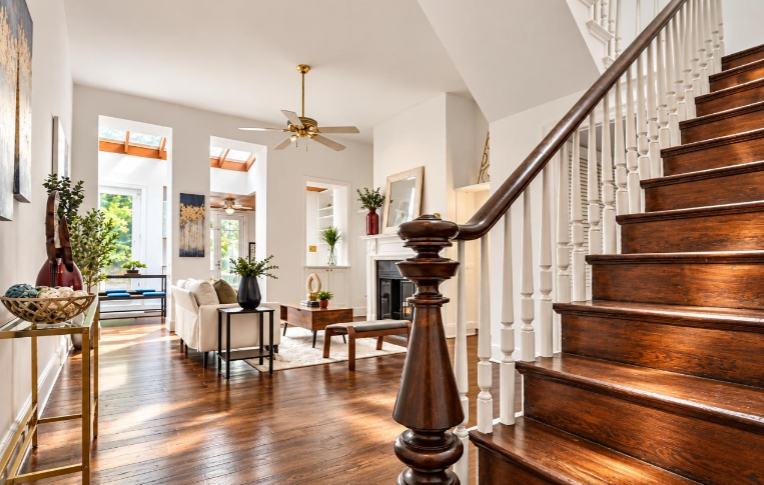
Every staging decision, from the largest furniture anchor to the final corner piece, is ultimately a question about the buyer. What does this buyer need to see in order to understand this room? What does this room need in order to communicate the lifestyle it is capable of enabling? What does this corner need in order to resolve the visual question the room is asking and allow the buyer’s eye to rest rather than search?
In professional home staging Washington DC, the answers to those questions are not aesthetic preferences. They are analytical conclusions drawn from an understanding of how buyers process spaces, how visual perception works, and what specific properties in specific markets need in order to compete effectively against every other listing a buyer will see that week.
The olive tree and the mirror are both good answers. The better answer depends entirely on what the room needs, what the buyer profile demands, and what the listing photograph will communicate to someone scrolling through dozens of competing options in thirty seconds. That is the decision Harvard Home Services makes in every corner of every staging, and the results speak consistently on behalf of the process.
For a foundational look at the psychological triggers that professional home staging Washington DC is designed to activate: The Psychology of Staging: The Top 3 Psychological Triggers Buyers Experience in a Professionally Staged Home
For Realtors managing listings where preparation and staging costs need to be deferred until settlement: What Every DMV Realtor Needs to Know About Staging for an Estate Sale
For recent examples of staging work across DC, Maryland, and Northern Virginia: Recent Staging Projects
Zero percent financing for sixty days. $650 to get started. Balance due at settlement.
Ready to Stage Your Next Listing?
Harvard Home Services partners with Realtors throughout Washington DC, Maryland, and Northern Virginia to prepare listings for market at the highest level. Services include:
- Professional home staging
- Luxury staging
- Real estate photography coordination
- Property preparation and cleaning
- Pre-listing consulting
Zero percent financing available for your sellers. $650 to get started, with the balance due at settlement from the proceeds of the sale.
William Milewski 202-361-5858 william.harvardhomeservices@yahoo.com
David Van Leeuwen 630-441-8000 david.harvardhomeservices@yahoo.com
Follow us on Instagram: instagram.com/harvardhomeservices
Find us on Thumbtack: Harvard Home Services on Thumbtack