
2D vs. 3D: The Moment a Home Stops Being Seen—and Starts Being Felt
William Milewski, Co-CEO of Harvard Home Services, defines two distinct ways a property is experienced by prospective buyers: a 2D presentation and a 3D experience .
A 2D presentation typically occurs during daytime hours and focuses on clarity, visibility, and information. Buyers are able to evaluate the layout, condition, and overall structure of the home. This is the standard way most properties are shown, photographed, and listed.
A 3D experience, however, introduces a completely different layer of perception. By incorporating late afternoon and early evening conditions, lighting, depth, and atmosphere begin to shape how a space is felt rather than simply observed .
This shift moves the buyer from analysis to emotional engagement.
Example 1

BEFORE (2D)

AFTER (3D)
Example 2

BEFORE (2D)

AFTER (3D)
Example 3

BEFORE (2D)
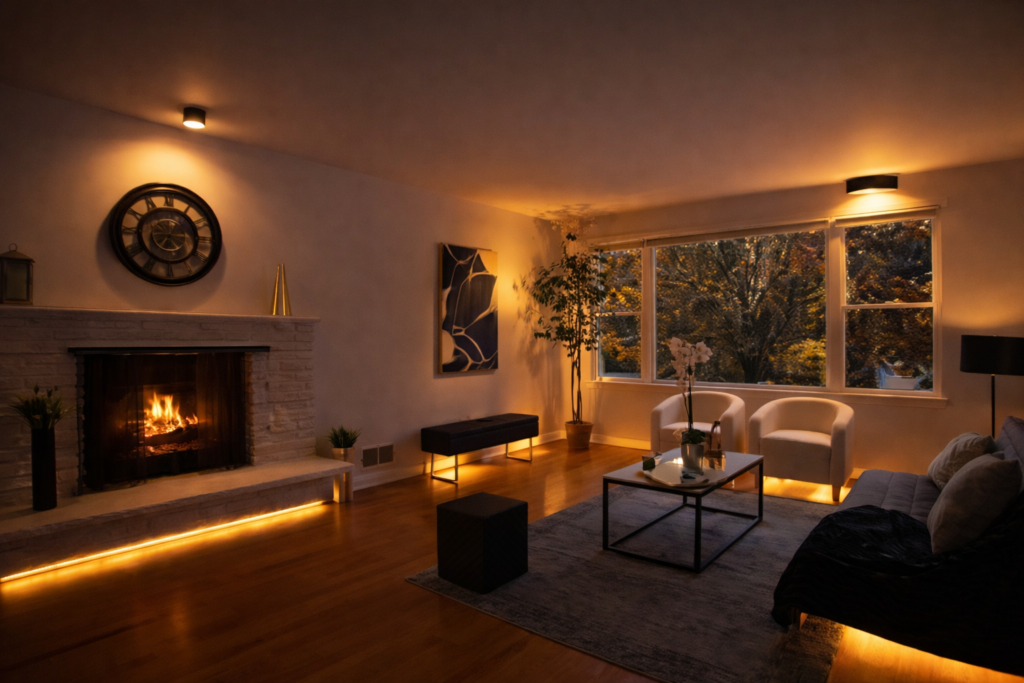
AFTER (3D)
Why Most Homes Are Presented in 2D
In a traditional real estate setting, homes are presented in a way that prioritizes information. Bright lighting, open visibility, and neutral conditions allow buyers to assess square footage, finishes, and layout.
This is effective for evaluation, but it lacks emotional impact.
Buyers can understand the home, but they do not necessarily feel connected to it.
This is where many listings fall short, especially in competitive markets like Washington DC, Northern Virginia, and Maryland, where presentation plays a major role in perceived value.
What Creates a 3D Experience in Home Staging
A 3D experience is not about changing the structure of a home. It is about changing how the space is perceived.
Lighting becomes the primary tool.
In the examples provided, the difference between 2D and 3D staging is immediately visible. The daytime presentation shows a clean and functional space. The evening presentation introduces warmth, depth, and contrast that transforms the environment .
Instead of simply seeing a living room, the buyer begins to imagine being in it.
Shadows soften edges. Warm lighting adds dimension. The space feels more complete and more lived in.
How Lighting Impacts Buyer Perception
Lighting is one of the most overlooked elements in home staging, yet it has one of the strongest effects on buyer psychology.
In a 2D presentation, light is even and flat. Everything is visible, but nothing stands out.
In a 3D presentation, lighting creates:
Depth
Contrast
Warmth
These elements make a space feel more inviting and more valuable.
As shown in the staging examples, the same room can feel completely different depending on how it is lit .
This is not just a design choice. It directly influences how buyers perceive the home.
From Evaluation to Emotional Connection
In a 2D environment, buyers are thinking:
How big is this room
What condition is this in
How does this compare to other homes
In a 3D environment, buyers begin to feel:
This space feels comfortable
I can see myself here
This home feels complete
That shift is critical.
Home staging is not just about making a home look better. It is about creating a connection that drives action.
Why This Matters in the Washington DC Market
In markets like Washington DC, Arlington, McLean, Bethesda, and the surrounding areas, buyers are often viewing multiple properties in a short period of time.
Homes that rely only on a 2D presentation blend together.
Homes that create a 3D experience stand out.
This is especially important for:
Luxury home staging
Townhomes and condominiums
Properties competing in high demand areas
The difference is not always in the property itself, but in how it is presented.
The Role of Professional Home Staging
At Harvard Home Services, we approach staging as more than just furniture placement. Every decision is made to influence how a buyer experiences the space.
This includes:
Lighting design
Furniture placement
Color balance
Visual flow
By combining these elements, we move beyond a basic presentation and create an environment that feels intentional and complete.
Conclusion
The difference between 2D and 3D home staging is the difference between being seen and being felt.
A 2D presentation allows buyers to understand a home.
A 3D experience allows buyers to connect with it.
That connection is what drives stronger interest, higher perceived value, and ultimately better outcomes when selling a property.